Wind Power Generation
The Ultimate Online Resource for Wind Power Generation
We install our Solar Trigenerationsm Energy Systems, for qualified commercial businesses, as well as cities, schools and government facilities with our Zero Up-front Cost program. For some customers - based on their present location, utility company and electric rate - we are able to reduce their electric rate by 10%. Even more for other customers. Solar Trigenerationsm Energy System! We provide the answers to your questions about solar power and energy! Does your; business, city, school, or electric utility want a more sustainable solar power and energy solution? Are you interested in transforming your facility, campus or building(s) to "Net Zero Energy" buildings? Does your city or school have a problem with rising electricity and energy expenses, but not have the financial resources to provide the necessary updates and upgrades to make your buildings more efficient? Maybe you have already decided to go solar, but you have a lot of questions, and don't know where to start. Call us, we have the answers to your solar questions. What is the optimum solar solution? There are hundreds of companies in the solar power and energy industry..... Who do you call to help you with these questions to help you make the right decisions? There's still more questions, that you may not have thought about..... which solar technology do you go with, and what is the return on investment? Are there any solar rebates, refunds, tax credits or other incentives available? What about investors that might be interested in owning/operating and maintaining our solar energy system under a Power Purchase Agreement? You have numerous questions and need the answers to help in the decision-making process regarding the solar power and energy system you want to install. These decisions will have a long-lasting impact as the solar energy system that you install at your business or facility will probably be generating clean power for the next 40 to 50 years, if not longer! So, the decisions that you need to make now regarding your solar energy system will be a decision that will be either a long-term asset or a liability, depending on the equipment you select and who you choose to install it. We can help cities, schools and commercial (and large residential) customers make the switch to solar! And now, with our no up-front cost for our Solar Trigenerationsm Energy System, we can also transform your building(s) to a "Net Zero Energy Building" and many times, actually REDUCE your present energy expenses by 10%, and possibly more! Examples of buildings/facilities where our Solar Trigenerationsm Energy Systems would benefit, include; universities, churches, data centers, shopping centers, schools, radio/television stations, food processing, warehouses, new real estate developments and subdivisions, and electric utilities - practically any commercial facility can be upgraded to one of our "pollution free power" systems featuring one of our solar energy systems, including our Solar Trigenerationsm system! Call or email us, we can provide these answers. We are focused on providing the optimum solar energy systems for our clients. This begins with an initial review of your past 12 months energy/electrical bills. The next step would include a site visit which may include a Demand Side Management study and/or a Solar Feasibility Study which determines the optimum solar energy system for your facility or location. Once the optimum solar solution(s) are determined, we then have a blueprint to proceed that could include our installing one of our Solar Cogeneration or Solar Trigenerationsm energy systems. Or for a city, real estate development or subdivision, or an electric utility, one of our utility scale power plants which might be a Concentrating Photovoltaic, Concentrating Solar Power or High Concentration Photovoltaic power plants.
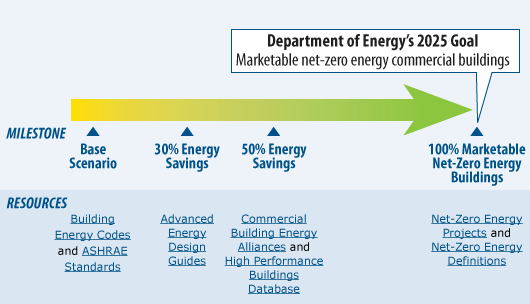
Net Zero
Energysm - when applied to a home or commercial building, simply means that
the home or buildings generates as much power and energy as they consume, when measured on a
monthly or annual basis, and with an onsite, renewable energy system, such as
our
Solar Trigenerationsm Energy
System. What is a Net Zero Energy Buildingsm? A Net Zero Energy Buildingsm produces as much energy as it uses over the course of a year. Net Zero Energy Buildingssm are very energy efficient. The remaining low energy needs are typically met with on-site renewable energy. First of all, understand that there is no such thing as a "zero energy building!" EVERY building uses energy, or you may as well be in a cave! The important considerations are, 1. How efficient is the building? 2. How much energy does the building use, and how efficiently is it used? 3. How much "carbon free energy" or "pollution free power" is generated by the buildings' own onsite renewable energy system? 4. What are the
utility company's prices for the excess power generated and sent to the
grid? 5. How difficult is it to interconnect the renewable energy system of the building with the utility company's powerlines/electric grid? At the heart of a Net Zero Energy Buildingsm is the idea that any building can meet its energy requirements from low-cost, locally available, nonpolluting, renewable sources, like our Solar Trigenerationsm Energy Systems. Our Solar Trigenerationsm Energy Systems are the idea whose time has come, to make Net Zero Energy Buildingssm commonplace. Solar Trigenerationsm Energy Systems Provide All of the Cooling, Heating & Power, for Any Size Building, with only the Energy of the Sun. Solar Trigenerationsm Energy Systems Provide Simultaneous Cooling, Heating & Power whether it is 12 Noon, or 12 Midnight, and can do so, WITHOUT Connection to the electric grid! The
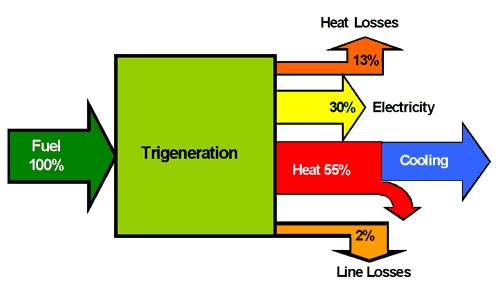
Diagram Below Shows How Our Solar Trigenerationsm Energy
System Works,
What is Net Energy Metering? Net energy metering is used to measure a customer's total electric
consumption against that customer's total on-site electric generation. When
a customer's onsite generation of power exceeds the amount that they use, the customer's
solar energy system (or other renewable energy system) exports the extra electricity to the
grid. When the power requirements of the customer exceeds their onsite
generation of power, the customer imports the electricity they need from
electric grid. The customer pays the electric company for any extra power they
use over the amount they generate - OR - the customer receives a credit or
refund from the electric company if they exported more power to the grid, than
what they consumed. Renewable Energy Is Necessary for Net Zero Energy BuildingsMuch focus is placed on energy efficiency as the most cost-effective way to reduce energy use in commercial buildings. However, consumption can be reduced only so much. There is a point at which the cost of adding efficiency measures is higher than that of using renewable energy such as thin film photovoltaics and other solar energy systems. Aggressive energy efficiency strategies can reduce a building's energy consumption by 50% to 70%. Renewable energy technologies must be used to reach the goal of a net-zero energy building (NZEB). Supply-Side TechnologiesVarious supply-side renewable energy technologies are available for Net Zero Energy Buildings. Supply-side technologies, often called energy producers, collect natural energy and transform it into a useful form. Examples of these technologies include PV, solar hot water, wind, hydroelectric, and biofuels. Ranking of Energy OptionsAll renewable sources are favorable over conventional energy sources such as coal and natural gas; however, the U.S. Department of Energy recommends the following ranking for these options (the lower numbers are preferable):
The goal in developing the ranking was to encourage technologies that:
Solar
Trigenerationsm Now,
Your Business Can Have Our Solar Trigeneration Through an affiliated partner company, we are now installing our Solar Trigeneration Energy Systems, for qualified commercial businesses, nationwide, with Zero up-front costs. Some customers may even see a decrease in their energy expenses by as much as 10% to 20% with our Zero up-front cost Solar Trigeneration Energy System! To qualify for our no up-front cost Solar Trigeneration Energy Systems, businesses must:
We expect ALL of our customers will be very happy knowing that the clean, green, renewable power they are using is:
Solar
Trigenerationsm
is Here! Our
"Solar
Trigenerationsm" Power and Energy Systems Solar Energy Systems provides cooler, cleaner, greener power and energy project development services. Our Solar Energy Systems are an environmentally-friendly and economically-superior choice to expensive natural gas and electricity. Additionally, our renewable energy technologies generate "green tags" or a Renewable Energy Credit. We provide
Solar
Power and Energy systems that we refer
to as "EcoGeneration" solutions that produce cooler,
cleaner, greener power and energy for our customers and our environment.
Unlike most companies, we are equipment supplier/vendor neutral.
This means we help our clients select the best equipment for their
specific application. This approach provides our customers with superior
performance, decreased operating expenses and increased return on
investment.
Net
Zero Energy Buildingssm The Audubon
Nature
| ||||||||||||||||||||||||||||||||||||||||||||||||||||||||||||||||||||||||||||||||||||||||||||||||||||||||||||||||||||||||||||||||||||||||||||||||||||||||||||||||||||||||||||||||||||||||||||||||||||||||||||||||||||||||||||||
| ## |
|
World CO2 since 1750 (cubic feet) |
The
carbon clock tracks total Carbon
Dioxide Emissions in metric tons since 1750.
Since 1750, humans have produced over 5 trillion pounds of Carbon
Dioxide Emissions into the atmosphere.
Roughly half of these Carbon Dioxide Emissions have ended up in the oceans where it is beginning to damage the coral reefs. The other half is still in the atmosphere and causing global warming.
Each
pound of Carbon Dioxide ("CO2") takes up as much space as a 500 pound
person.
The formula (which should be good for a year or two) is:
C(t) = 2.58 ×10¹² + 1240×t, where t is seconds since the start of 2007.
C is tonnes (metric tons) of Carbon
Dioxide Emissions.
2205 x C gives pounds of Carbon
Dioxide Emissions.
That comes to over 43 billion tons/year or over 86 trillion pounds/year.
Carbon dioxide is made up from 1 carbon atom with 2 oxygen atoms, or simply,
"CO2."
Carbon
has relative weight 12 and Oxygen 16. Therefore, it takes only 12 pounds
of carbon to make 12+16+16 = 44 pounds of Carbon Dioxide (CO2).
Wind Power Generation Saves Water!
20% of our nation's electricity requirements can be generated with wind power generation by the year 2030 according to the Department of Energy.
When we do, our nation will save over 4 Trillion gallons of water through 2030 through the displacement of typical electric power plants, such as fossil fuel power plants, that would have used vast amount of water. By switching to wind power generation for 20% of our nation's electrical requirements, we reduce overall water consumption by 17% in 2030.
See our website at: www.WindPowerGeneration.com for more information.
According to R. James Woolsey, for Director of the Central Intelligence Agency, "The basic insight is to realize that global warming, the geopolitics of oil, and warfare in the Persian Gulf are not separate problems --- they are aspects of a single problem, the West's dependence on oil."
According to a report by the United Nations:
"It is estimated that Greenhouse
Gas Emissions
trading markets could be worth $2 Trillion by 2012."
Click on following link to see the complete article.
http://www.unep.org/Documents.Multilingual/Default.asp?DocumentID=433&ArticleID=4792&l=en
More Information At:
www.GreenhouseGasEmissions.com
for more information
The
Future is "Carbon Free Energy"
and
"Pollution Free Power"
- according to the
Renewable Energy Institute
The Renewable Energy Institute has determined "carbon free energy" and "pollution free power" are the best possible solutions for the many economic, environmental and political/geo-political and societal problems caused by fossil fuels.
The Renewable Energy Institute is made up of the brightest minds, professors, climatologists, engineers, politicians and universities. Their "crystal ball" sees "renewable energy" and "renewable energy technologies" as the best path forward for providing the energy the world needs. And it's no longer any energy that will do - the future is for energy that is clean, sustainable, renewable, and "Carbon Free Energy" and "Pollution Free Power."
According to Mont Goodell, Founder, Chairman and President of the Renewable Energy Institute, "we must become less dependent on unstable, foreign oil and energy supplies and reduce our 'addiction' to fossil fuels so that we can become energy independent - so that we will not be held hostage by counties with large supplies of fossil fuels such as Iran, Venezuela or Russia, countries that we cannot rely on as our allies or friends."
Continuing, Mr. Goodell adds, "Since energy and power are the lifeblood of our economy - and we need to 'transition' away from the use of all fossil fuels, and ultimately discontinue the use of fossil fuels so that we can stop and reverse the pollution from Carbon Dioxide Emissions and Greenhouse Gas Emissions. So, this begs the question, 'how do we provide for the energy and power that we need that keeps our economy healthy'? The answer and the future is quite simply, 'renewable energy and renewable energy technologies.'"
Renewable
energy includes; B100 Biodiesel, Biomass / Biomass
Gasification, Biomethane, E100
Ethanol, Geothermal, Solar,
Waste to Energy (including Waste
to Fuel and Waste to Watts) and Wind.
These renewable energy technologies
produce "carbon free energy" and
"pollution free power."
This will reverse the problems caused by fossil fuels which include global
warming and climate change. Renewable energy technologies will improve our
country's energy security, economy and reduce the trade deficit.
The Economic and Environmental Benefits of Wind Power
According to the Department of Energy, our nation's electricity generation from wind power alone could top 20 percent of the total power generation mix by 2030.
This would have the economic benefits of creating 500,000 jobs and generate more than $400 billion.
Wind Power also reduces Greenhouse Gas Emissions and other pollution by 25 percent than otherwise.
Wind
Power Generation:
Growing Faster Than Any Other
Form of Renewable Energy!
|
Installed Windpower Generation (in
Megawatts) by Country |
||||
| Rank | County | 2005 | 2006 | 2007 |
| 1 | Germany | 18,415 | 20,622 | 22,247 |
| 2 | United States | 9,149 | 11,603 | 16,818 |
| 3 | Spain | 10,028 | 11,615 | 15,145 |
| 4 | India | 4,430 | 6,270 | 8,000 |
| 5 | China | 1,260 | 2,604 | 6,050 |
| 6 | Denmark (& Faeroe Islands) | 3,136 | 3,140 | 3,129 |
| 7 | Italy | 1,718 | 2,123 | 2,726 |
| 8 | France | 757 | 1,567 | 2,454 |
| 9 | United Kingdom | 1,332 | 1,963 | 2,389 |
| 10 | Portugal | 1,022 | 1,716 | 2,150 |
| 11 | Canada | 683 | 1,459 | 1,856 |
| 12 | Netherlands | 1,219 | 1,560 | 1,747 |
| 13 | Japan | 1,061 | 1,394 | 1,538 |
| 14 | Austria | 819 | 965 | 982 |
| 15 | Greece | 573 | 746 | 871 |
| 16 | Australia | 708 | 817 | 824 |
| 17 | Ireland | 496 | 745 | 805 |
| 18 | Sweden | 510 | 572 | 788 |
| 19 | Norway | 267 | 314 | 333 |
| 20 | New Zealand | 169 | 171 | 322 |
| 21 | Egypt | 145 | 230 | 310 |
| 22 | Belgium | 167 | 193 | 287 |
| 23 | Taiwan | 104 | 188 | 282 |
| 24 | Poland | 83 | 153 | 276 |
| 25 | Brazil | 29 | 237 | 247 |
| 26 | South Korea | 98 | 173 | 191 |
| 27 | Turkey | 20 | 51 | 146 |
| 28 | Czech Republic | 28 | 50 | 116 |
| 29 | Morocco | 64 | 124 | 114 |
| 30 | Finland | 82 | 86 | 110 |
| 31 | Ukraine | 77 | 86 | 89 |
| 32 | Mexico | 3 | 88 | 87 |
| 33 | Costa Rica | 71 | 74 | 74 |
| 34 | Bulgaria | 6 | 36 | 70 |
|
Texas Wind
Power Map
|
|
![]() |
Renewable Energy Project Development Solutions
and Greenhouse Gas Emissions Services
About
Us
We provide our clients with comprehensive renewable energy
project development services. This includes "waste
to energy" solutions that utilizes our in-house engineering services -
on a vendor-neutral basis. For clients, we help them choose the best path forward
with our
engineering feasibility and economic studies. Once our clients
and our company understands the specific needs, requirements and goals of our
clients, we can then optimize the waste to energy solution, that might include
one or more of our products and services, including; anaerobic
digester, biomass gasification
plant, cogeneration plant, natural
wastewater treatment plant, trigeneration
plant or other waste to energy or
waste to fuel solution.
begin most and assist our commercial and industrial clients by providing recommendations and strategies for helping them reduce their carbon emissions, carbon dioxide emissions, greenhouse gas emissions and keep informed of current laws and pending legislation relating to climate change, global warming and how they can prepare for Cap and Trade. See our website at: www.CapAndTrade.net for more information on Cap and Trade issues, pending legislation and preparing for federal laws and compliance.
Our clients benefit from our extensive experience and knowledge of issues relating to renewable energy, environmental and sustainability issues as well as implementing real world solutions that accomplish our client's goals and objectives.
We have been providing products, consulting services, information, education and solutions for reducing:
Carbon Emissions (www.CarbonEmissions.com)
Carbon Dioxide Emissions (www.CarbonDioxideEmissions.com)
and Greenhouse Gas Emissions (www.GreenhouseGasEmissions.com) since 2003.
No company is better prepared to help their clients in meeting
these legal and environmental challenges with proven solutions that help save
money through significantly lower energy expenses while simultaneously reducing
or eliminating their Greenhouse Gas
Emissions, or eliminating them entirely,
than us! We are the pioneers of "Carbon Free
Energy,"
"Pollution Free Power" and "Clean Power Generation" strategies and
solutions that can completely eliminate your company's Greenhouse Gas
Emissions. Our solutions and strategies provide our customers with an integrated approach to today's climate challenges with real world solutions that solve these problems, while reducing energy expenses.
Our solutions include:
We turn your waste into green power and energy! Stop "Wasting Waste!"
Biomass
Gasification Engineering and Feedstock Feasibility Studies
Turnkey Biomass Gasification plants
Greenhouse Gas Emissions Inventory
Greenhouse Gas Emissions Assessment
Greenhouse Gas Emissions
Carbon Footprint verification
Sustainability Assessment
Automated Demand Response
Biomass Gasification
Carbon Free Energy
Cogeneration plants
Demand Side Management
Pollution Free Power
Clean Power Generation
Renewable Energy Technologies
Solar Cogeneration
Solar Desalination
Solar Detoxification
Solar Trigeneration
Trigeneration plants
Utility Scale Power Plants
Wind Farm Development
Why Choose Us?
We have proven solutions, products and services that
can reduce or completely eliminate your company's Greenhouse Gas Emissions. Our
staff and team has the technical expertise, depth of knowledge and
affiliations with major universities that are on the cutting edge of research
that is developing the solutions the world needs to solve these problems. And,
we are taking these university solutions to market with products and services
that solve the challenges and problems relating to climate change, fossil fuels
and greenhouse gas emissions. In fact, we don't see these as problems any
longer, but opportunities to help our clients get the jump on their competition,
and our solutions are providing our customers with a sustainable, and durable
competitive advantage.
Frequently Asked Questions
How does our company receive credit for our early actions at reducing our
Greenhouse Gas Emissions?
Before taking action independently, companies should first contact us so that we
can help them establish a Greenhouse Gas Emissions "inventory" which
we can provide as a qualified third-party.
What is the generally accepted format for sustainability reports?
At present, most companies are using the Global Reporting Initiative (GRI)
protocols as this provides for the "triple bottom line" reporting which includes
social, economic and environmental performance measurements. We also line to
include in our triple bottom line "people, planet and profit."
What are the benefits of verifying
your company's Greenhouse Gas Emissions?
1. Satisfies regulatory compliance
regulations as well as accounting regulations relating to accuracy in reporting to customers,
stockholders and other company stakeholders.
2. Prepare for present and future regulatory compliance - Cap and Trade is coming!
3. Establishes a present-day baseline for receiving future Greenhouse Gas Emissions Credits when your company begins taking action to reduce Greenhouse Gas Emissions.
4. Provides a blueprint and strategy for knowing how, where and when to begin reducing your company's Greenhouse Gas Emissions.
We also help clients with tax credits when they use renewable energy
technologies
such as the Synthesis Gas produced from Biomass Gasification plants.
Section
45 Tax Credits
Renewable Energy Tax Credits
Our renewable
energy project development expertise has made us a leading authority of
helping our clients with Section 45 Tax Credits. Our company and our
attorneys are skilled in the areas of renewable energy project finance and
tax issues relating to renewable energy projects. We are able to assist
our clients in connection with Section 45 tax credit project finance.
Our experience in Section 45 tax credits has helped us structure optimal
renewable energy project solutions that match our clients unique economic
and tax goals and requirements, which include regulatory constraints and
regulatory compliance for most any state.
Section 45 tax credits generate $.021 cents per kwh of electricity
produced by the taxpayer and sold to an unrelated person or company.
Section 45 tax credits are available for renewable electricity produced
from certain renewable energy projects including, closed-loop biomass,
open-loop biomass, geothermal power plants, solar energy, small irrigation
power, municipal solid waste, and qualified hydro power production,
refined coal and wind power generation.
See one of our following sites at:
www.Section45TaxCredits.com or www.RenewableEnergyTaxCredits.com
for more information or call: (832) 758 - 0027 for more information
_____________________________________________________
Renewable Energy Ventures is a privately-held company started by two of the directors at the Renewable Energy Institute.
Renewable Energy Ventures provides Biomass Gasification engineering and Biomass Gasification
project development services.
Moving forward with us - next steps
Typically, we are engaged by new clients after they have identified renewable energy or renewable fuel opportunity. We require an initial retainer from new clients. The amount of the retainer is based upon the number of hours and resources for the specific project. Our Phase I feasibility studies are led by a licensed professional engineer that holds a Ph.D. in engineering along with significant experience in biomass, renewable energy and waste to energy technologies.
After completing the engineering feasibility and economic study, we are then able to move forward with the EPC (Engineering-Procurement-Construction) project development and would provide several of the key project management team members.
We
Package, Sell and Install Highly-efficient
Cogeneration and Trigeneration
energy systems
Trigeneration Technologies, LLC. is a privately held company that was founded by
two of the board members of the Renewable Energy Institute. We assist in
the optimization of bulk power systems by engineering, developing, installing,
owning and operating highly efficient cogeneration
and trigeneration energy systems.
Our specialty is both both cogeneration and trigeneration energy systems. There is probably not a better, more cost-effective "demand side management" method for reducing the energy expenses for commercial businesses.
We manufacture/package, sell and install cogeneration and trigeneration energy systems that approach 100% net system efficiency. This means our energy systems utilize nearly 100% of the fuel in the form of power (electricity) and hot water and/or steam with our cogeneration energy systems and cooling, heating and power (electricity) with our trigeneration energy systems - that our customers use "onsite" in their buildings, restaurants, health clubs, hotels, casinos, office buildings, hospitals and many other types of commercial buildings, facilities and plants.
For qualified clients, we will build-design-finance-own-operate and maintain our cogeneration or trigeneration energy systems.
What is "Trigeneration"?
Trigeneration is the simultaneous production of three forms of energy - typically, Cooling, Heating and Power - from only one fuel input. Put another way, our trigeneration power plants produce three different types of energy for the price of one.
Our company's trigeneration energy systems reach overall system efficiencies of 86% to 93%. Typical "central" power plants, that do not need the heat generated from the combustion and power generation process, are only about 33% efficient.

Trigeneration
Diagram & Description
Trigeneration Power Plants' Have the
Highest System Efficiencies and are
About 300 % More Efficient than Typical Central Power Plants
Trigeneration plants are installed at locations that can benefit from all three forms of energy. These types of installations that install trigeneration energy systems are called "onsite power generation" also referred to as "decentralized energy."
One of our company's principal's first experience with the design and development of a trigeneration power plant was the trigeneration power plant installation at Rice University in 1987 where our trigeneration development team started out by conducting a "cogeneration" feasibility study. We installed a 4.0 MW Ruston gas turbine for the power plant. Rice University selected an EPC company that installed the trigeneration power plant, along with waste heat recovery boilers and absorption chillers. A "waste heat recovery boiler" captures the heat from the exhaust of the gas turbine. From there, the recovered energy was converted to chilled water - originally from (3) Hitachi Absorption Chillers - 2 were rated at 1,000 tons each, and the third Hitachi Absorption Chiller was rated at 1,500 tons. The Hitachi absorption chillers were replaced shortly after their installation by the EPC company. The first trigeneration plant at Rice University was so successful, they added a second 5.0 MW trigeneration plant so today, Rice University is now generating about 9.0 MW of electricity, and also producing the cooling and heating the university needs from the trigeneration plant and circulating the trigeneration energy around its campus.

Trigeneration Chart
Trigeneration's
"Super-Efficiency" compared
with other competing technologies
As you can see, there is No Competition for Trigeneration!
Our trigeneration power plants are
the ideal onsite power and energy solution for customers that include:
Data Centers, Hospitals, Universities, Airports, Central Plants, Colleges &
Universities, Dairies, Server Farms, District Heating & Cooling Plants, Food
Processing Plants, Golf/Country Clubs, Government Buildings, Grocery Stores,
Hotels, Manufacturing Plants, Nursing Homes, Office Buildings / Campuses,
Radio Stations, Refrigerated Warehouses, Resorts, Restaurants, Schools, Server
Farms, Shopping Centers, Supermarkets, Television Stations, Theatres and
Military Bases.
We partner and collaborate with other forward thinking companies and communities that are interested in changing the outdated power and energy model of the past - inefficient and highly-polluting central power plants that average 33% efficiency - to a new paradigm and model for the future - community-based cogeneration and trigeneration energy systems at more than 90% efficiency - and therefore provides power and energy at lower prices while significantly reducing and even eliminating typical power plant emissions and greenhouse gas emissions.
Call (832) 758 - 0027 for more information about community-based cogeneration and trigeneration energy systems or about making your community, hospital, university or other commercial facility a model for the future.
At about 86% to 93% net system efficiency, our trigeneration power plants are about 300% more efficient at providing energy than your current electric utility. That's because the typical electric utility's power plants are only about 33% efficient - they waste 2/3 of the fuel in generating electricity in the enormous amount of waste heat energy that they exhaust through their smokestacks.
Trigeneration is defined as the simultaneous production of three energies: cooling, heating and power. Our trigeneration energy systems use the same amount of fuel in producing three energies that would normally only produce just one type of energy. This means our customers that have our trigeneration power plants have significantly lower energy expenses, and a lower carbon footprint.
Our trigeneration power plants can produce 42 degree F. chilled water (with a 20 degree chilled water option) as well as steam and hot water while generating at least 200 kW of power. We can build trigeneration power plants up to 10 MW and with system efficiencies approaching 100%.
Our trigeneration plants can use renewable fuels such as Biomethane, B100 Biodiesel or Dimethyl Ether, instead of fossil fuels to run them. We also offer an optional selective catalytic reduction technology that takes NOx down to "non-detect" without the use of ammonia or urea on our new trigeneration plants.
Our range of services (some provided by affiliate companies or manufacturing suppliers) include:
Design/engineering, Engineering Feasibility and Economic Analysis Studies
Legal
Energy Service Agreements
Power Purchase Agreements
Build
Finance
Own
Operate
Maintain
Long Term Service Agreements
Our renewable energy projects generate Renewable Energy Credit or Certified Emission Reduction credits, which provide an additional income stream from our projects.
"The Trigeneration
Experts" - the ONLY
Company that Builds Integrated Trigeneration
Plants on a Single Skid with Effective System Efficiencies that Exceed 90%.
Our Optional SCR System Reduces Nitrogen Oxides To "Non-Detect"
Without Ammonia or Urea
Our
small footprint Trigeneration
Plants measurements are: 15'
wide by 15' in height by and 55' in length
We Can Design, Build, and
Install Your New Trigeneration
Power Plant and have it
online in less than 130 - 150 days!
Our "Turnkey" Integrated Trigeneration
Energy Systems are Available from 60 kW to over 10 MW with system efficiencies
> 90% While Providing Practically-free Heating (and Cooling with
Trigeneration) and generating power for commercial and industrial customers for
as low as 4 cents/kW! We are the only company that builds, fabricates,
packages (on a single skid) and "integrates" Trigeneration
power plants.
Cogeneration and Trigeneration Power Plants sizes in MW:
1 MW
2 MW 3 MW
4 MW 5 MW
NOTE:
We will NOT use the following:
Capstone microturbines
Daewoo engines
GE Power
Jenbacher
Kawasaki turbines
Guascor engines
in ANY of our cogeneration or
trigeneration power plants.
Our
territory includes the U.S.A., Canada, the Caribbean
and Central America.
We can package any combination of standard size plants to come up with your optimum size system. Our standard and customized Trigeneration power plants use the leading brands of reciprocating engines or turbines and include our proprietary Waste Heat Recovery technologies that help us achieve system efficiencies greater than 90% and effective heat rates as low as 4050 btu's/kW. We provide both standard and customized Trigeneration plants that meet our customer's most stringent economic and environmental requirements.
Our Power Plants can run on renewable fuels for even greater environmental and economic savings! These fuels or energy sources include: Biomethane, B100 Biodiesel, Dimethyl-Ether, Synthesis Gas and natural gas. Net system efficiencies of our Trigeneration power plants are now exceeding 90% with up to 95% lower emissions when using Biomethane, B100 Biodiesel, Dimethyl-Ether or Synthesis Gas as the fuel for Trigeneration power plants.
For pricing and delivery information on our Cogeneration, Trigeneration, Biomethane or B100 Biodiesel power plants, call (832) 758 - 0027 or send an email with your project's requirements to: info@trigeneration.com
Read more about our Trigeneration Power Plants on our Specifications page.
Our
New "Integrated" Trigeneration
Plants Have
Very High Efficiencies & Low Fuel Costs
The Effective Heat Rate is Approximately
4050 btu/kW & System Efficiency is 92%
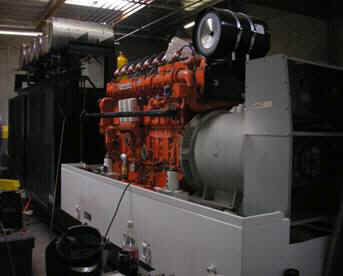
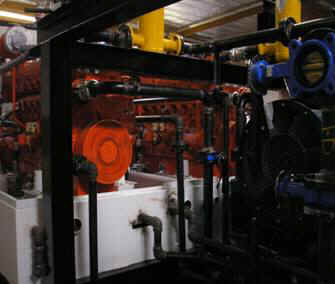
Pictures
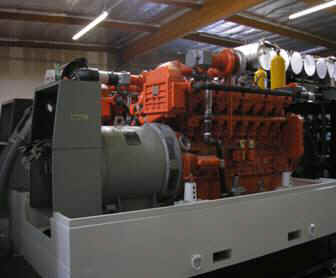
of our latest Cogeneration Plant Presently Being Built for New Customer.
This Cogeneration Plant is Rated at 900 kW and Features (2) Natural Gas Engines
@ 450 kW each on one Skid.


Our
onsite trigeneration power and energy system can be an ideal solution for
customers wanting increased power reliability and decreased energy and
environmental costs. A few of the types of buildings and businesses that
would benefit from an onsite trigeneration plant include the following:
Airports
Casinos
Central Plants
Colleges & Universities
Dairies
Data Centers & Server Farms
District Heating & Cooling plants
Food Processing Plants
Golf/Country Clubs
Government
Buildings and Facilities
Grocery Stores
Hospitals
Hotels
Manufacturing Plants
Military
Bases
Nursing Homes
Office
Buildings / Campuses
Radio Stations
Refrigerated
Warehouses
Resorts
Restaurants
Schools
Server Farms
Shopping centers
Supermarkets
Television Stations
Theatres
For pricing and delivery information on our cogeneration or trigeneration energy systems, call (832) 758 - 0027 or send an email with your goals, objectives and requirements to: info@trigeneration.com
____________________________________________________________________________________
Biomass
Gasification
www.BiomassGasification.com
Biomass Gasification is One of the
Few
Technologies that Produces "Carbon Negative Energy"
We provide turnkey Biomass Gasification Solutions for
the Following Biomass Waste Streams
Agricultural Waste
Breweries
Coal
C&D - Construction and Demolition Debris/Waste
Cotton Gin Waste
Cow Manure
Dairy Manure
DDGS
Distilleries
Ethanol Plants
Food Processing
Food Waste
Forest Residue
Forestry Waste
Glycerin
MSW - Municipal Solid Waste
Petroleum Coke
Railroad Ties
Paper Sludge
Peanut Hulls
Poultry Litter
Refuse Derived Fuel
Rice Husks
Sewage Sludge
Timber
Urban Wood Waste
Waste Coal
Wastewater
Wineries
Wood/Wood waste
Wood Chips
and many more!
____________________________________________________________________________________
When
It Comes to Energy Independence,
Biomethane, Not Coal, is America's "Ace in the Hole"
and One of the Greenest of All Biofuels
It's
Time to Start Building Our Country's Biomethane Infrastructure &
Producing Biomethane, the Cleanest/Greenest Biofuel!
By: M.E. Goodell, M.B.A.
Biomethane Technologies
www.Biomethane.com
Biomethane,
NOT Coal, is America's True "Ace in the Hole" when it comes to our
energy future, economics, the environment, sustainability and America's
“Energy Independence.” And biomethane
is also receiving recognition as one of the greenest of all biofuels.
For
years now, the coal industry has been touting "coal is America's 'Ace in
the Hole'" when they discuss the abundance of our coal reserves here in the
U.S. and the role they hope coal will play in America's energy future.
But
coal is far from being the “Ace in the Hole” the coal lobby would have
everyone believe. That’s due to
the proverbial “black eye” not to mention the “black lungs” and other
problems that are inherent with “dirty coal.”
While
there may be a place for coal in America's energy future, coal must become
"clean" for America to value it as a possible energy resource. Plans
or building 18 new coal fired
power plants were cancelled in Texas last year due to the fact that coal
isn't clean, and utilities aren't interested in investing the extra costs for
building power plants that use "Clean
Coal Technology" or "Integrated
Gasification Combined Cycle" power plants that also now need to include
"Carbon Capture and
Sequestration" technologies to remove the carbon
dioxide emissions from the stacks. Plans for many other coal fired power
plants are being cancelled. And even now, owners of coal fired power plants (pulverized
coal) are switching from coal, to biomass, and biomass
gasification technologies, as the writing is on the wall.
Unless our society relishes the thoughts of moving back to the caves, and using candles, and foregoing our modern-day comforts, we need to move forward with renewable energy technologies such as biomethane, as the alternative is power shortages and blackouts.
We
believe biomethane and synthesis
gas represents the best
and greenest of all biofuels. There are no supply problems with biomethane,
and we have a virtually unlimited supply for using biomethane
wherever natural gas is presently used as a fuel.
It
should be pointed out that biomethane is
chemically no different than natural gas from the "fossil fuel" form
of natural gas or CH4.
However,
one important distinction between biomethane
and the fossil-fuel variety of natural gas, is that the production and use of biomethane
is “carbon neutral” in that the greenhouse
gas emissions from biomethane use do
not add any new net greenhouse
gas emissions.
Biomethane
starts out as “biogas” but must be cleaned and purified before it can be
used as a renewable fuel. The
process of cleaning and purifying the biogas is called “biogas
to biomethane.” The impurities
that are found in biogas include hydrogen sulfides, siloxanes, and carbon
dioxide. When the impurities are removed from biogas, it is then referred to as biomethane
and available for use as a clean fuel, just as the fossil-fuel form of natural
gas is used.
Biomethane
reserves and supplies, unlike fossil-fuel natural gas, are virtually unlimited. Biomethane
is produced from many sources including anaerobic
digesters, wastewater
treatment systems, landfills and landfill
gas to energy projects and most agricultural and forestry operations. Last
year, the first Biomethane NGV refueling station was opened in Eugendorf,
Austria. Like a gas station provides
gasoline for cars, the the NGV Biomethane station in Eugendorf provides biomethane
for NGVs (Natural Gas Vehicles).
Presently, the station provides a blend of biomethane
and natural gas. Eventually, they
hope to provide 100% biomethane
for natural gas vehicles. Companies
and researchers in Germany and Austria have determined that “Cellulosic
Biomethane”
is the greenest of all biofuels, and the least expensive biofuel to produce.
Germany and Austria are now planting vast amounts of a form of Kentucky
Bluegrass which will be harvested for use in producing “Cellulosic
Biomethane,”
through anaerobic digesters and fermentation.
Researchers
from around the world, starting in Austria, are finding that grasses such as
Kentucky Bluegrass are easily converted into biomethane
as well as organic fertilizer. Cellulosic
Biomethane production doesn’t require the fermentation of sugars or
starches - as the first generation of liquid biofuels – requiring grains and
oilseeds from food crops. As the Austrian Cellulosic
Biomethane project shows, biomethane
can be produced from a cellulosic biomass feedstock like grass. Yield estimates
from the Austrian Cellulosic
Biomethane research indicate that one natural gas vehicle can travel 10,000
to 15,000 miles on just one acre of Kentucky Bluegrass that was processed into biomethane.
At
a Jan. 8, 2009 public workshop held by the California Natural Gas Vehicle
Coalition, they documented the superior benefits and potential of biomethane
as a clean, renewable energy resource. The
California Natural Gas Vehicle Coalition stated that biomethane
should be classified as a "Super Ultra Low Carbon fuel."
Super Ultra Low Carbon fuel is defined as providing at least an 82
percent reduction in greenhouse gas emissions - based on the California Air
Resource Board’s analysis of biomethane from landfill gas.
Biomethane
has a carbon dioxide emissions
intensity of only 11 as compared with:
67.9 for natural gas
95.8 for diesel
96.7 for gasoline
Biomethane
can displace and substitute the equivalent of 29% percent of all petroleum
diesel transportation fuel used - almost immediately.
According
to the California Energy Commission and the Biomass Collaborative, landfills,
wastewater treatment, and dairy waste sources - which are "developable
today" and can start producing biomethane
almost immediately, with low investment/high returns, could yield 121 billion
cubic feet of biomethane. At $8.00/mmbtu,
that's a $1 billion market opportunity in California alone.
The 121 billion cubic feet of Biomethane
equals about 860 million gallons of petroleum diesel. California alone uses
about 3 billion gallons of diesel annually for transportation. Emerging biomass
gasification and Biomethanation
technologies could more than double biomethane
supplies.
Biomethane
- like natural gas from "fossil fuels" - can be transported in the
form of either compressed natural
gas or liquefied natural gas.
And using "Compressed
Biomethane" is a significantly better choice as a transportation fuel
than traditional "natural gas."
Biomethane
is the "renewable natural gas"
and is far better for the environment and the economy than natural gas. Biomethane,
when "vented" to the environment, is 21 times more hazardous to the
climate than carbon dioxide
emissions which are the only emissions (and water vaport) from compressed
natural gas vehicles' engines when used as a fuel.
Again,
we are reminded that biomethane is the
same chemical compound as natural gas: CH4, and completely replaces and
substitutes for natural gas. Engines, turbines, boilers and every other natural
gas appliance can use biomethane without
any adjustments or modifications - just like natural gas.
Biomethane
supplies, as opposed to natural gas supplies from the fossil fuel industry, are
available in an unlimited supply.
Moving
forward with a “Biomethane Infrastructure” is the direction our country
needs to be moving as one of our fuel choices as we become energy-independent.
Every MCF of biomethane
that we use displaces about 8 gallons of gasoline and creates jobs that will
never be outsourced or downsized.
(Some
of the above information from the California Natural Gas Vehicle Coalition.)
Please
Support H.R. 1158, The Biogas Production Incentive Act of 2009
to Help Create our Nation's Biomethane Infrastructure
& Biomethane Reserves
SUMMARY:
The Biogas Production Incentive Act of 2009 if enacted, will amend the
Internal Revenue Code to allow a business-related tax credit for the production,
sale, or use of biogas. Defines biogas as a gas that is derived by processing
qualified energy feedstock (i.e., manure of agricultural livestock and other
organic agricultural or food industry byproduct waste material) in an anaerobic
digester and that contains at least 52% methane and carbon dioxide and trace
gases. Provides an increased credit for biogas produced from qualified
cellulosic energy feedstock.
Dear Senator or Representative ________
I
am writing to you in support of HR 1158, the Biogas Production Incentive Act of
2009 and recommend that Congress develops and passes this much needed
legislation that provides a $4.27 per MMBTU tax credit for the production of
Biogas – also known as "Renewable Natural Gas," "Renewable
Biogas" or "Biomethane."
H.R. 1158, the Biogas Production Incentive Act would establish this tax
credit that will help jumpstart this vital industry.
Renewable biogas and biomethane have been heralded by many as being the
greenest of all biofuels. Biomethane
has a carbon dioxide emissions intensity of only 11 as compared with 67.9 for
natural gas, 95.8 for diesel and 96.7 for gasoline.
Biomethane can displace and substitute the equivalent of 29% percent of
all petroleum diesel transportation fuel used - almost immediately.
The California Natural Gas Vehicle Coalition stated that Biomethane
should be classified as a "Super Ultra Low Carbon fuel."
Super Ultra Low Carbon fuel is defined as providing at least an 82
percent reduction in greenhouse gas emissions - based on the California Air
Resource Board’s analysis of biomethane from landfill gas.
The
U.S. Congress has wisely supported the expanded use of domestic renewable
resources through a variety of tax incentives and other programs.
Up to this point, Congress has focused primarily on measures that support
the production of renewable liquid transportation fuels or electricity.
In the U.S., however, natural gas represents 23 percent of the energy
consumed.
Natural
gas is the fuel of choice to provide residential and commercial heat for space
and hot water in most applications and is used to produce steam in a variety of
commercial and industrial applications. Natural gas is also the fuel that
provides the energy to manufacture many industrial products including aluminum,
steel, glass, chemicals, fertilizer, and ethanol.
Incentivizing
the production of renewable natural gas or "Biomethane" from sources
that include animal manure, landfills, renewable biomass and agricultural wastes
will support expanding the role of renewables into this existing energy sector,
where little opportunity exists today.
It will also create another business investment prospect for renewable
project developers and the potential to expand rural economies while supporting
existing industrial jobs and dramatically reducing carbon emissions.
Please
consider the following:
•
Renewable Biomethane is a versatile form of bio-energy. It can be used
directly at the site of production, or placed in the pipeline to support a
variety of residential commercial or industrial applications.
•
Renewable Biomethane produced from renewable sources including animal
manure, landfills, renewable biomass and agricultural wastes can be produced at
high efficiencies ranging from 60–70 percent.
Additionally, all of the technology components to produce renewable gas
from this variety of sources exist today.
•
Renewable Biomethane can be delivered to customers via the existing U.S.
pipeline infrastructure.
•
Renewable Biomethane can provide a renewable option for many heavy
industries, which could save existing industrial jobs in a carbon constrained
economy - while creating new rural green jobs to produce Renewable Biomethane.
•
Renewable Biomethane production in digesters provides the agricultural
sector additional environmental benefits by improving waste management and
nutrient control.
We believe this is a fiscally responsible proposal that will provide the
following benefits:
•
Jump-start new biomethane gas production
•
Begin the creation of the biomethane infrastructure and biomethane
industry
•
Increase biomethane “reserves”
•
Creation of green jobs
•
Expand the rural economy and increase revenues for farming and
agricultural operations
•
Increase energy independence
•
Reduce greenhouse gas emissions.
Thank
you for your support and consideration of this legislation.
Sincerely,
_______________________
Signature and address
Please
write to your Representative and Senators, and ask them to support H.R. 1158 and
the $4.27 per MMBTU tax credit for the production of Biomethane/Renewable
Natural Gas, using the above letter as a suggested letter you are welcome to use
as your own.
Thank
you!
For more information on Biomethane, see www.Biomethane.com
Wind Energy Terminology & Glossary
AC - Alternating Current
Airfoil -The cross section profile of the leeward side of a wind generator
blade. Designed to give low drag and good lift. Also found on an airplane wing.
Air Gap - In a
permanent magnet alternator, the distance between the magnets and the laminates.
Alternating Current -
Electricity that changes direction periodically. The period is measured in
Cycles per Second (Hertz, Hz).
Alternator - A device
that produces Alternating Current from the rotation of a shaft.
Amperage - A unit of
electrical current, equal to Coulombs per second. This is the flow rate of
electrons moving through a circuit, very roughly analogous to gallons per minute
flowing from a faucet.
Ampere-Hour - A
measure of energy quantity, equal to amperes times hours. Also used to measure
battery capacity.
Anemometer - A device
that measures wind speed.
Angle of Attack - The
angle of relative air flow to the blade chord.
Annealing - A heat
treatment process that makes Cold-rolled steel more suitable for forming and
bending.
Area of a Circle - Pi
multiplied by the Radius squared.
Armature - The moving
part of an alternator, generator or motor. In many PM alternator designs, it
carries the magnets and is attached to the blades and hub. Also called a Rotor.
Axial Alternator - An
alternator design where a flat disc carrying magnets on the face (the Armature)
rotates near a flat disc carrying coils (the Stator).
Axis - The centerline
of a rotating object's movement.
Balancing - With wind
turbine blades, adjusting their weight and weight distribution through 2 axes so
that all blades are the same. Unbalanced blades create damaging vibration.
Battery - An
electrochemical device for storing energy.
Battery Bank - An
array of Batteries connected in series, parallel, or both.
Bearing - A device
that transfers a force to structural supports. In a wind generator, bearings
allow the Shaft to rotate freely, and allow the machine to Yaw into and out of
the wind.
Belt - A device for
transferring power from a rotating shaft to a generator. Allows the use of
Pulleys to change the ratio of shaft speed to and from the generator.
Betz Limit -59.3
percent. This is the theoretical maximum efficiency at which a wind generator
can operate, by slowing the wind down. If the wind generator slows the wind down
too much, air piles up in front of the blades and is not used for extracting
energy.
Blade - The part of a
wind generator rotor that catches the wind.
Braking System - A
device to slow a wind turbine's shaft speed down to safe levels electrically or
mechanically.
Bridge Rectifier - An
array of diodes used to convert Alternating Current to Direct Current.
Single-phase bridge rectifiers use 4 diodes, 3-phase bridge rectifiers use 6
diodes.
Brushes - Devices for
transferring power to or from a rotating object. Usually made of
carbon-graphite.
Ceramic Magnets - See
Ferrite Magnets.
Chord - The width of a
wind turbine blade at a given location along the length.
Coercivity--The amount
of power needed to magnetize or demagnetize a permanent magnet. Measured in
MegaGauss Oersted (mGO)
Cogging - The cyclic
physical resistance felt in some alternator designs from magnets passing the
coils and gaps in the laminates. Detrimental to Start-up.
Coil - A length of
wire wound around a form in multiple turns.
Cold-Rolled Steel -
Steel processed by working at room temperatures. More expensive than hot-rolled
steel.
Commutator - The
rotating part of a DC generator.
Concave - A surface
curved like the interior of a circle or sphere.
Convex - A surface
curved like the exterior of a circle or sphere.
Current - See
Amperage.
Cut-In Wind Speed -
The rotational speed at which an alternator or generator starts pushing
electricity hard enough (has a high enough voltage) to make electricity flow in
a circuit.
Cycles per Second -
Measured in Hertz. In electricity, it is the number of times an AC circuit
reaches both minimum and maximum values in one second.
Darrieus Wind Turbine
- A Vertical Axis Wind Turbine design from the 1920s and 1930s by F.M. Darrieus,
a French wind turbine designer.
DC - Direct Current
Delta - A 3-phase
alternator wiring configuration in which all phases are connected in Series.
Diameter - A straight
line passing through the center of a circle, and ending on both edges. Equal to
2 times the Radius.
Diode - A solid-state
device that allows electricity to flow in only one direction.
Downwind - Refers to a
Horizontal Axis Wind Turbine in which the hub and blades point away from the
wind direction, the opposite of an Upwind turbine.
Drag - In a wind
generator, the force exerted on an object by moving air. Also refers to a type
of wind generator or anemometer design that uses cups instead of a blades with
airfoils.
Dump Load - A device
to which wind generator power flows when the system batteries are too full to
accept more power, usually an electric heating element. This diversion is
performed by a Shunt Regulator, and allows a Load to be kept on the Alternator
or Generator.
Duty Cycle - In a
circuit, the ratio of off time to on time.
Dynamo - A device that
produces Direct Current from a rotating shaft. See Generator.
Eddy Currents -
Currents that flow in a substance from variations in magnetic induction. See
also Lenz Effect. Laminates are used to prevent eddy currents, which cause
physical and electrical resistance in an alternator or transformer, therefore
wasting power.
Efficiency - The ratio
of energy output to energy input in a device.
Electromagnet - A
device made of wire coils that produces a magnetic field when electricity flows
through the coils.
Epoxy - A 2-part
adhesive system consisting of resin and hardener. It does not start to harden
until the elements are mixed together. NOT compatible with Fiberglas® Resin.
Excitation - Using an
electric current to create a magnetic field. See Electromagnet.
Fatigue - Stress that
causes material failure from repeated, cyclic vibration or stress.
Ferrite Magnets - Also
called Ceramic Magnets. Made of Strontium Ferrite. High Coercivity and Curie
Temperature, low cost, but brittle and 4-5 times weaker than NdFeB magnets.
Fiberglas®
Resin--Another 2-part adhesive system, NOT compatible with Epoxy. Often used for
making castings, since it is much cheaper than Epoxy.
Freewheeling - a wind
generator that is NOT connected to a Load is freewheeling, and in danger of
self-destruction from overspeeding.
Frequency - Refers to
electric current - Also see Cycles per Second.
Furling - The act of a
wind generator Yawing out of the wind either horizontally or vertically to
protect itself from high wind speeds.
Furling Tail - A wind
generator protection mechanism where the rotor shaft axis is offset horizontally
from the yaw axis, and the tail boom is both offset horizontally and hinged
diagonally, thus allowing the tail to fold up and in during high winds. This
causes the blades to turn out of the wind, protecting the machine.
Gauss - A unit of
magnetic induction, equal to 1 Maxwell per square centimeter. Higher Gauss
measurements mean more power can be induced to flow in an alternator. Gauss
readings can be increased by putting steel behind magnets, stacking magnets, or
using larger or higher-grade magnets.
Gearing - Using a
mechanical system of gears or belts and pulleys to increase or decrease shaft
speed. Power losses from friction are inherent in any gearing system.
Generator - A device
that produces Direct Current from a rotating shaft.
Governor - A device
that regulates the speed of a rotating shaft, either electrically or
mechanically.
Guy Anchor - Attaches
tower guy wires securely to the earth.
Guy Radius - The
distance between a wind turbine tower and the guy anchors.
Guy Wire - Attaches a
tower to a Guy Anchor and the ground.
H-Rotor - A Vertical
Axis Wind Turbine design.
HAWT - Horizontal Axis
Wind Turbine.
Hertz - Frequency
measurement. See Cycles per Second
Horizontal Axis Wind
Turbine - A "normal" wind turbine design, in which the shaft is
parallel to the ground, and the blades are perpendicular to the ground.
Hub - The center of a
wind generator rotor, which holds the blades in place and attaches to the shaft.
Impedance - See
Resistance.
Induction - The
production of a magnetic field by the proximity of a electric charge or the
production of a magnetic field by proximity of an electric charge.
Induction Motor - An
AC motor in which the rotating armature has no electrical connections to it (ie
no slip rings), and consists of alternating plates of aluminum and steel.
Kilowatt - 1000 Watts
(see Watt)
kW - Kilowatt.
Laminations--Electrical
circuit core parts, found in motors, generators, alternators and transformers.
When core parts are subjected to alternating electrical or magnetic fields, the
buildup of Eddy Currents causes physical and electrical power loss. Laminations
are made of thin strips of materials that make good temporary magnets and poor
permanent magnets, and each strip is insulated electrically from the next.
Leading Edge - The
edge of a blade that faces toward the direction of rotation.
Leeward - Away from
the direction from which the wind blows.
Lenz Effect - See also
Eddy Currents. From H.F.E Lenz in 1833. Electromotive force is induced with
variations in magnetic flux. It can be demonstrated physically in many different
ways--for example dragging a strong magnet over an aluminum or copper plate, or
shorting the terminals of a PM alternator and rotating the shaft by hand.
Laminates are used to reduce power losses from this effect.
Lift - The force
exerted by moving air on asymmetrically-shaped wind generator blades at right
angles to the direction of relative movement. Ideally, wind generator blades
should produce high Lift and low Drag.
Live - A circuit that
is carrying electricity.
Load - Something
physical or electrical that absorbs energy. A wind generator that is connected
to a battery bank is loaded. A disconnected wind generator is NOT loaded, so the
blades are free to spin at very high speed without absorbing any energy from the
wind, and it is in danger of destruction from overspeeding.
Losses - Power that is
harvested by a wind generator but is not transferred to a usable form. Losses
can be from friction, electrical resistance, or other causes.
Magnet - A body that
attracts ferromagnetic materials. Can be a Permanent magnet, Temporary Magnet,
or Electromagnet.
Magnetite - A common
Iron-containing mineral with ferromagnetic properties.
Magnet Wire - The kind
of wire always used in making electromagnets, alternators, generators and
motors. Uses very thin enamel insulation to minimize thickness and maximize
resistance to heat.
Magnetic Circuit - The
path in which magnetic flux flows from one magnet pole to the other.
Magnetic Field -
Magnetic fields are historically described in terms of their effect on electric
charges. A moving electric charge, such as an electron, will accelerate in the
presence of a magnetic field, causing it to change velocity and its direction of
travel. An electrically charged particle moving in a magnetic field will
experience a force (known as the Lorentz force) pushing it in a direction
perpendicular to the magnetic field and the direction of motion. Also called
magnetic flux.
Maximum Energy Product
- Determines how good a magnet that different materials can make. Technically,
the amount of energy that a material can supply to an external magnetic circuit
when operating within its demagnetization curve.
MegaGauss Oersted -
Magnetic force measurement, see Maximum Energy Product.
MGOe - MegaGauss
Oersted.
Moment - A force
attempting to produce motion around an axis.
NdFeB - See
Neodymium-Iron-Boron Magnet.
Nacelle - The
protective covering over the generator or motor at the top of a wind turbine
tower.
Neodymium-Iron-Boron
Magnet - The composition of the most powerful Permanent Magnets known to man.
The materials are mined, processed, and sintered into shape. Then, they are
subjected to an extremely strong magnetic field and become Permanent Magnets.
Ohm's Law - The basic
math needed for nearly all electrical calculations. Please see a dictionary or
Pocket Ref for all of the variations on Ohm's Law! E=I*R (voltage(E)=amperage(I)*resistance(R)),
and all of the algebraic variations of this (I=E/R, R=E/I). Also, for DC
circuits, Watts=Volts*Amps. For AC circuits, Watts=Amps * Volts * Cosine of
phase angle theta.
Open-Circuit Voltage -
The voltage that a alternator or generator produces when it is NOT connected to
a Load.
Parallel - In DC
electrical circuits such as a battery bank or solar panel array, this is a
connection where all negative terminals are connected to each other, and all
positive terminals are connected to each other. Voltage stays the same, but
amperage is increased. In AC circuits such as a wind generator alternator, each
parallel coil is connected to common supply wires, again increasing amperage but
leaving voltage the same. Opposite of Series. See also Star.
Permanent Magnet - A
material that retains its magnetic properties after an external magnetic field
is removed.
Permanent Magnet
Alternator - An Alternator that uses moving permanent magnets instead of
Electromagnets to induce current in coils of wire.
PM - Permanent Magnet.
PMA - See Permanent
Magnet Alternator.
Phase - The timing of AC current cycles in different wires. 3-phase alternators produce current that is cyclically timed between 3 different wires and a common wire, while single phase produces it in only 1 wire and a common. In a 3-phase alternator, wire #1 receives a voltage peak, then wire #2 receives a peak, then wire #3.
Pillow Blocks -
Bearings that support a horizontal shaft.
Pitch - Setting Angle
of an airfoil or blade.
Poles - A way of
picturing magnetic phenomena. All magnets are considered to be
"dipoles", having both a North pole (which would point North if used
in a compass) and a South pole (which would point South if used in a compass. In
an alternator, generator, or motor the number of Poles is a measure of how many
coils, permanent magnets or electromagnets are in the armature or stator.
Prop - Propeller.
Propeller - The
spinning thing that makes an airplane move forward. Often incorrectly used to
describe a wind turbine Rotor.
Pulley - A device for
transferring power when using Belts as Gearing. Changing to smaller or larger
Pulleys changes the gear ratio, and can be used to make a shaft turn faster or
slower than the shaft that is providing its power.
Pulse Width Modulation
- A regulation method based on Duty Cycle. At full power, a
pulse-width-modulated circuit provides electricity 100 percent of the time. At
half power, the PWM is on half the time and off half the time. The speed of this
alternation is generally very fast. Used in both solar wind regulators to
efficiently provide regulation.
PWM - See Pulse Width
Modulation.
Radius - The distance
between the center of a circle and the outside.
Rare-Earth Magnets -
See Neodymium-Iron-Boron magnets.
Rated Power Output -
Used by wind generator manufacturers to provide a baseline for measuring
performance. Rated output may vary by manufacturer. For example, one
manufacturer's 1500 watt turbine may produce that amount of power at a 30 mph
windspeed, while another brand of 1500 watt turbine may not make 1500 Watts
until it gets a 40 mph windspeed. Read manufacturer's ratings statements
very carefully.
Rectifier - See Diode.
Radial - An alternator
design in which the armature magnets are attached to the outside circumference
of a disc, with the stator coils mounted around the outside.
Regulator - A device
to adjust incoming power so as to avoid overcharging a battery bank. In solar
power, the regulator generally just turns the solar array off when the batteries
are full. With a wind generator, the regulator generally diverts all or part of
the incoming power to a Dump Load when the batteries fill, thus keeping a Load
on the wind generator so it will not Freewheel.
Relay - An
electromechanical switch that uses a small amount of incoming electricity to
charge an electromagnet, which physically pulls down a connecting switch to
complete a circuit. This allows a low-power circuit to divert the electricity in
a high-power circuit.
Resistance - The
voltage per amp needed to make electricity flow through a wire. See Ohm's Law.
Root - The area of a
blade nearest to the hub. Generally the thickest and widest part of the blade.
Rotor--1) The blade and hub assembly of a wind generator. 2) The disc part of a
vehicle disc brake. 3) The armature of a permanent magnet alternator, which
spins and contains permanent magnets.
RPM - Revolutions Per
Minute. The number of times a shaft completes a full revolution in one minute.
Savonius - A
vertical-axis wind turbine design by S.J. Savonius of Finland from the 1920s and
30s. Shaped like a barrel split from end to end and offset along the cut. They
are drag machines, and thus give very low rpm but lots of torque.
Series - In DC
electrical circuits such as a battery bank or solar panel array, this is a
connection where all the negative terminals are connected to the neighboring
positive terminals. Voltage increases, but amperage stays the same. In AC
circuits such as a wind generator alternator, each coil is connected to the one
next to it, and so on, again increasing voltage but leaving amperage the same.
Opposite of Parallel. See also Delta.
Servo Motor - A motor
used for motion control in robots, hard disc drives, etc. Generally designed
more like an alternator than a standard motor, most Servos need special control
circuitry to make them rotate electrically. Some can be used in reverse to
generate alternating current.
Setting Angle - The
angle between the blade Chord and the plane of the blade's rotation. Also called
Pitch or blade angle. A blade carved with a Twist has a different setting angle
at the Tip than at the Root.
Shaft - The rotating
part in the center of a wind generator or motor that transfers power.
Short Circuit - 1)
Parts of a circuit connected together with only the impedance of the leads
between them. 2) In wind generators, connecting the output leads directly
together so as to heavily load a generator in high winds. This creates a
"short" circuit path back to the generator, bypassing all other loads.
Shunt - An electrical
bypass circuit that proportionally divides current flow between the shunt and
the shunted equipment. It also allows high current measurements with low-current
equipment.
Shunt Regulator - A
bypass device for power not needed for charging batteries. When batteries are
full, the regulator shunts all or part of the excess power to a Dump Load to
protect the batteries from overcharging damage.
Slip Ring - Devices
used to transfer electricity to or from rotating parts. Used in wound-field
alternators, motors, and in some wind generator yaw assemblies.
Star - A coil
connection scheme for 3 phase alternators and generators in which all 3 coil
phases are connected in parallel--they all share a common connection.
Start-Up - The
windspeed at which a wind turbine rotor starts to rotate. It does not
necessarily produce any power until it reaches cut-in speed. See Cut-in Wind
Speed.
Stationary - With wind
generator towers, a tower that does not tilt up and down. The tower must be
climbed or accessed with a crane to install or service equipment at the top.
Stator - The part of a
motor, generator or alternator that does not rotate. In permanent magnet
alternators it holds the coils and laminates.
Tail - See Vane. The
proper term is actually Vane, but Tail is commonly used.
Tail Boom - A strut
that holds the tail (Vane) to the wind generator frame.
Tape Drive Motor - A
type of permanent magnet DC motor often used as a generator in small wind
generator systems.
Taper - The change in
wind turbine blade width (chord) along the length.
Temporary Magnet - A
material that shows magnetic properties only while exposed to an external
magnetic field.
Thrust - In a wind
generator, wind forces pushing back against the rotor. Wind generator bearings
must be designed to handle thrust or else they will fail.
Thrust Bearing - A
bearing that is designed to handle axial forces along the centerline of the
shaft--in a wind generator, this is the force of the wind pushing back against
the blades.
Tilt-Up - A tower that
is hinged at the base and tilted up into position using a gin pole and winch or
vehicle. Wind turbines on tilt-up towers can be serviced on the ground, with no
climbing required.
Tip - The end of a
wind generator blade farthest from the hub.
Tip Speed Ratio -The
ratio of how much faster than the windspeed that the blade tips are moving.
Abbreviation TSR.
Torque - Turning
force, equal to force times radius. See also Moment.
Tower - A structure
that supports a wind generator, usually high in the air.
Trailing Edge - The
edge of a blade that faces away from the direction of rotation.
Transformer - Multiple
individual coils of wire wound on a laminate core. Transfers power from one
circuit to another using magnetic induction. Usually used to step voltage up or
down. Works only with AC current.
TSR - Tip Speed Ratio.
Turn - In winding
stator coils, this is one loop of wire around a form. A coil will often be
referred to by how many turns of a certain gauge wire are in each coil.
Twist - In a wind
generator blade, the difference in Pitch between the blade root and the blade
tip. Generally, the twist allows more Pitch at the blade root for easier
Startup, and less Pitch at the tip for better high-speed performance.
Upwind - the direction
in which a wind turbine generator faces into the wind.
Vane - A large, flat
piece of material used to align a wind turbine rotor correctly into the wind.
Usually mounted vertically on the tail boom. Sometimes called a Tail.
Variable Pitch - A
type of wind turbine rotor where the attack angle of the blades can be adjusted
either automatically or manually.
VAWT - Vertical Axis
Wind Turbine.
Vertical Axis Wind
Turbine - A wind generator design where the rotating shaft is perpendicular to
the ground, and the cups or blades rotate parallel to the ground.
Voltage - A measure of
electrical potential difference. One volt is the potential difference needed in
a circuit to make one Ampere flow, dissipating one Watt of heat.
Volt-Amp - In an AC circuit, this is Volts * Amps, without factoring in the power factor, derived from the phase angle.
Watt - One Joule of
electrical energy per second. In DC circuits, Watts=Volts * Amps. In AC
circuits, Watts=Volts * Amps * the cosine of the phase angle. See also Volt-Amp.
Wild AC - Alternating
Current that varies in Frequency.
Wind Generator - A
device that captures the force of the wind to provide rotational motion to
produce power with an alternator or generator.
Windmill - A device
that uses wind power to mill grain into flour. But informally used as a synonym
for wind generator or wind turbine, and to describe machines that pump water
with wind power.
Wind Turbine - A
machine that captures the force of the wind. Called a Wind Generator when used
to produce electricity. Called a Windmill when used to crush grain or pump
water.
Windward - Toward the
direction from which the wind blows.
Yaw - Rotation
parallel to the ground. A wind generator Yaws to face winds coming from
different directions.
Yaw Axis--Vertical
axis through the center of gravity.
Some of the above information provided with our thanks by the Department of Energy and the National Renewable Energy Laboratory.
____________________________________________________________________________________
April 18, 2009
By: Webmaster
www.CarbonDioxideEmissions.com
www.CarbonEmissions.com
www.GreenhouseGasEmissions.com
WASHINGTON — In a major reversal of years of government policy regarding Greenhouse
Gas Emissions, the Environmental Protection Agency today proposed regulating
Greenhouse Gas Emissions to
combat and reverse global warming and climate change.
"In both magnitude and probability, climate change is an enormous problem" said E.P.A's Administrator Lisa Jackson in their 130 page report on Greenhouse Gas Emissions. "This finding confirms that greenhouse gas pollution is a serious problem now and for future generations. Fortunately, it follows [US President Barack H. Obama's] call for a low-carbon economy and strong leadership in Congress on clean energy and climate legislation. Greenhouse Gas Emissions and greenhouse gas pollution problems have a solution, one that will create millions of green jobs and end our country's dependence on foreign oil," according to Jackson.
Jackson said this report found that projected levels of Greenhouse Gas Emissions "endanger the public health and welfare of current and future generations." The finding came two years after the Supreme Court ruled the EPA had the authority to regulate Greenhouse Gas Emissions under the Clean Air Act.
"Renewable Energy Technologies such as; Anaerobic Digesters, Biomethane, Concentrating Solar Power, Geothermal Power Plants are "carbon neutral energy" technologies, and generate no new Greenhouse Gas Emissions. Power generated from Biomass Gasification power plants, are "carbon negative energy" solutions which actually remove carbon dioxide emissions from the atmosphere, according to the Founder and Chairman of the Institute for Climate Solutions, and the Renewable Energy Institute's Mont Goodell.
For
more information, see the Greenhouse
Gas Emissions website at: www.GreenhouseGasEmissions.com
____________________________________________________________________________________
President-elect Obama has pledged to significantly reduce Greenhouse Gas Emissions.
The price tag for reducing Greenhouse Gas Emissions ranges from a low of $150 billion to a high of over $1 Trillion/year, every year, for the next 20 years, plus an additional $9.3 Trillion according to the article “Is Obama’s Energy Plan Enough?” by Time Magazine (Nov. 22, 2008)
http://www.time.com/time/health/article/0,8599,1859040,00.html?imw=Y
In the third to last paragraph of this article, it states, “And if we want to increase the share of renewables — and control the growth of greenhouse gas emissions — we'll need to spend an additional $9.3 trillion, if we're aiming to stay below the 2 degree C warming max recommended by the Intergovernmental Panel on Climate Change. (Of course, an increasing number of scientists argue that we need to avoid even that level of warming.) "We would need concerted action from all major emitters," said Nabuo Tanaka, the head of the IEA.
The United Nations has stated that “the market for Greenhouse Gas Emissions Credits will be valued at $2 Trillion by 2012.”
____________________________________________________________________________________
Suggested Links for More Information:
www.AutomatedDemandResponse.com
www.BuildingIntegratedPhotovoltaic.com
www.BuildingIntegratedPhotovoltaics.net
www.CarbonCaptureAndSequestration.com
www.CarbonDioxideEmissions.com
www.CertifiedEmissionReduction.com
www.CertifiedEmissionReductions.com
www.CleanDevelopmentMechanism.net
www.ConcentratedSolarPower.com
www.ConcentratedSolarThermal.com
www.ConcentratingSolarThermal.com
www.ConcentratingPhotovoltaic.com
www.ConcentrationPhotovoltaic.com
www.ConcentratingSolarPower.com
www.ConcentratorPhotovoltaic.com
www.ConcentratorPhotovoltaics.com
www.CopperIndiumGalliumDiselenide.com
www.EmissionReductionCredit.com
www.EmissionReductionCredits.com
www.EmissionsReductionCredit.com
www.EmissionsReductionCredits.com
www.EnergyConservationMeasures.com
www.EnergyEfficiencyMeasures.com
www.EnergyEfficientLighting.net
www.EngineeringProcurementConstruction.com
www.EngineeringProcurementAndConstruction.com
www.EuropeanUnionAllowance.com
www.EuropeanUnionAllowances.com
www.EvacuatedTubeCollector.com
www.EvacuatedTubeCollectors.com
www.FinancialTransmissionRights.com
www.GreenhouseGasEmissions.com
www.HighConcentrationPhotovoltaic.com
www.HighVoltageDirectCurrent.com
www.IntegratedSolarCombinedCycle.com
www.InterconnectionAgreement.com
www.InterconnectionAgreements.com
www.LocationalMarginalPricing.com
www.MechanicalElectricalPlumbing.com
www.MonocrystallineSilicon.com
www.MulticrystallineSilicon.com
www.ParabolicTroughCollector.com
www.ParabolicTroughCollectors.com
www.ParabolicTroughPowerPlant.com
www.ParabolicTroughPowerPlants.com
www.PhotovoltaicPowerPlant.com
www.PolycrystallineSilicon.com
www.PowerPurchaseAgreement.com
www.PowerPurchaseAgreements.com
www.RenewableEnergyCapital.net
www.RenewableEnergyInvestments.com
www.RenewableEnergySystems.net
www.RenewableEnergyTaxCredit.com
www.RenewableEnergyTaxCredits.com
www.RenewableEnergyTechnologies.com
www.RenewableEnergyVentures.com
www.RenewablePortfolioStandard.com
www.SolarElectricPowerSystem.com
www.SolarElectricPowerSystems.com
www.SolarHeatingAndCooling.com
www.SolarInvestmentTaxCredits.com
www.SolarPhotovoltaicPanels.com
www.SolarThermalCollectors.com
www.SolarThermalPowerPlants.com
www.SolarWaterHeatingSystem.com
www.SolarWaterHeatingSystems.com
www.TransmissionCongestionRights.com
www.TransmissionSuperhighway.com
www.UtilityScalePowerPlant.com
www.VerifiedEmissionReduction.com
www.VerifiedEmissionsReductions.com
Are
you doing your part to stop Global Warming and Climate Change?
Learn more about the leading causes of Global Warming and Climate Change,
which are Carbon
Dioxide Emissions and Greenhouse
Gas Emissions at the following websites:
Carbon
Dioxide Emissions
www.CarbonDioxideEmissions.com
Carbon Emissions
www.CarbonEmissions.com
Greenhouse Gas Emissions
www.GreenhouseGasEmissions.com
Our
solar energy systems will;* eliminate or greatly reduce our customer's electric demand charges and electric expenses.
* slow, stop and eventually reverse climate change by reducing and then
eliminating anthropogenic greenhouse
gas emissions - of which carbon
dioxide emissions makes up 80% of all greenhouse
gas emissions.
* reduce and eventually eliminate the use of coal and other fossil fuels.
*
reduce the need for inefficient and expensive central power plants owned by
utility companies.
* promote energy independence.
* end America's dependence on oil from OPEC and other countries in the Middle-East, Venezuela and end our need for importing natural gas from Russia.
____________________________________________________________________________________
We support the Renewable Energy
Institute by donating a portion of our profits to the Renewable
Energy Institute in their efforts to reduce fossil fuel use through
renewable energy and their goals to end pollution from Carbon
Dioxide Emissions and Greenhouse
Gas Emissions.
The Renewable Energy Institute is "Changing The Way The World Makes and Uses Energy by Providing Research & Development, Funding and Resources That Create Pollution Free Power, Carbon Free Energy & Renewable Energy Technologies".

![]()
![]()
www.RenewableEnergyInstitute.org
Email: info(@)Renewable Energy Institute (.)org
The information contained on this site is
copyright protected and
cannot be
reproduced in any form or manner without our consent.
Wind Power Generation
www.WindPowerGeneration.com
Email: info@WindPowerGeneration.com
Tel. (832) 758 - 0027
Copyright © 1999 - 2009
All Rights Reserved